
Sell Silver for Cash in Central New Jersey
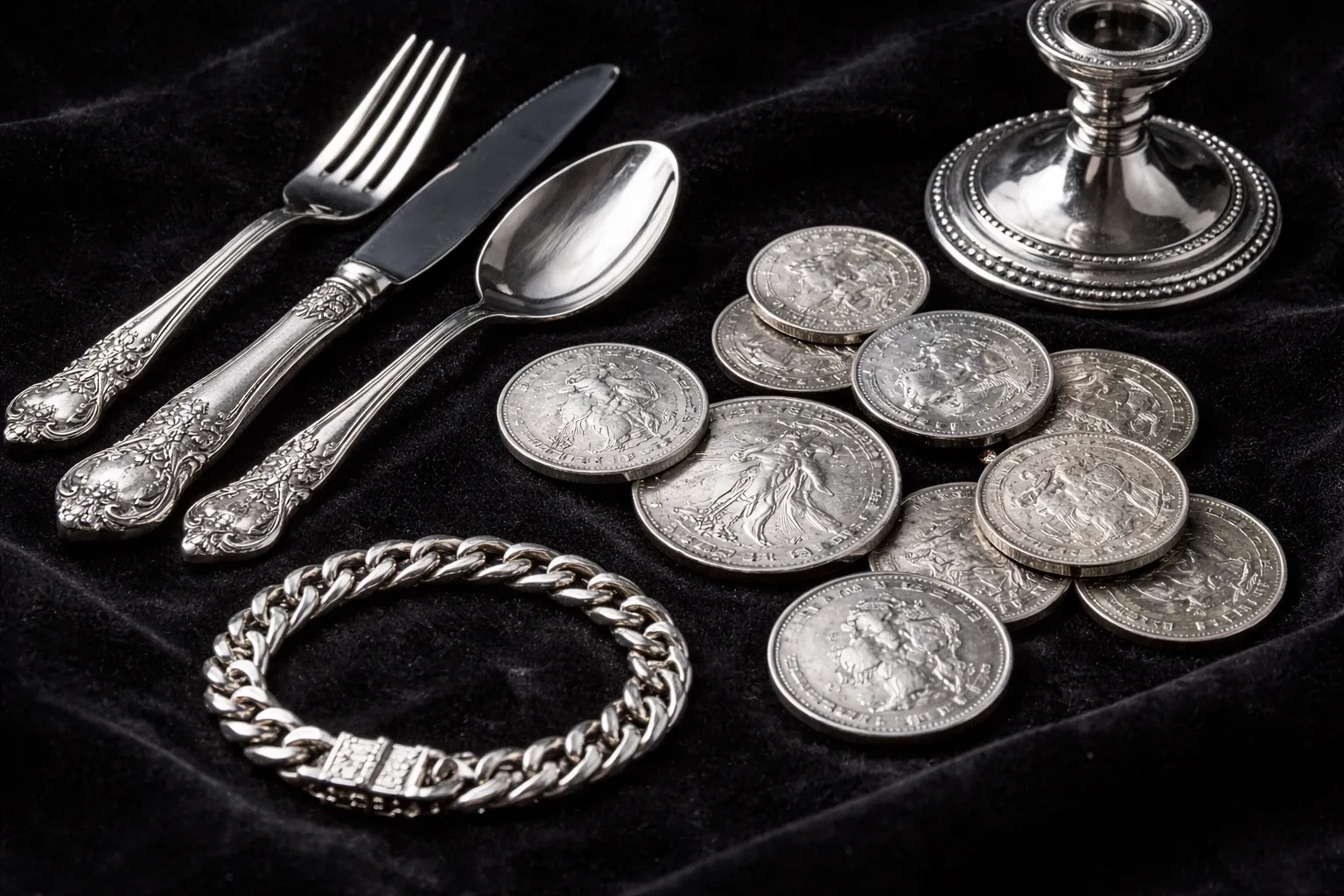
Sterling silver, silverware, coins, jewelry. We buy it all at top market prices.
Why Sell Silver to Cash 4 Gold?
Real-Time Market Prices
We pay based on live silver spot prices. When silver is up, your payout is up.
We Beat Competitors
Got a quote elsewhere? Bring it in. We'll match or beat any legitimate offer.
Accurate Weighing
Certified scales and transparent weighing process. See exactly what you're getting paid for.
All Silver Welcome
Tarnished, damaged, or pristine. Silver is silver, and condition doesn't affect melt value.
Understanding Silver Value
Types of Silver We Buy
- Sterling Silver (.925):: Jewelry, flatware, tea sets. Stamped "925" or "Sterling"
- Fine Silver (.999):: Bullion bars, some coins. Highest purity
- Coin Silver (.900):: Pre-1965 US coins (dimes, quarters, half dollars)
- Silver Plate:: We can evaluate; some pieces have value
Why Silver Has Real Value
Silver is a precious metal used in jewelry, electronics, solar panels, and medicine. Unlike costume jewelry that's worthless when broken, silver always retains its metal value regardless of condition.
What to Bring
- ✓ Sterling silver jewelry (rings, chains, bracelets)
- ✓ Flatware sets (forks, knives, spoons)
- ✓ Tea sets, trays, candlesticks
- ✓ Silver coins (US and foreign)
- ✓ Silver bullion bars and rounds
- ✓ Scrap silver in any condition
Pro Tip: Check Your Kitchen
Many people have inherited silverware sitting unused. That old flatware set from grandma could be worth $500-$2,000+ depending on weight and pattern. We'll tell you in minutes.
Silver Purity Quick Reference
Not all silver is the same purity. Here's a breakdown of what you'll commonly encounter and where each type shows up:
Not sure what you have? That's normal. Most people don't. Bring it in and we'll identify the purity for free in under a minute.
What Determines Your Silver Payout
Silver pricing has some quirks that catch people off guard. Here's how we calculate it:
Purity: The Make-or-Break Factor
Sterling silver (.925) is 92.5% pure silver and pays real money. Silver plate is a base metal dipped in a thin silver coating, so there's almost no silver to recover and payout is minimal. This is the single biggest variable we see catch people by surprise.
Weight in Troy Ounces
Silver is priced per troy ounce (31.1g). A heavy sterling flatware set can easily weigh 500+ grams, which is over 16 troy ounces of silver. Weight matters a lot here, which is why flatware and tea sets often surprise people with their value.
Tarnish Does Not Reduce Value
Black, patchy, oxidized: it doesn't matter. Tarnish is a surface reaction that does nothing to the silver underneath. We don't discount for tarnish. Don't bother polishing before you come in; it wastes your time and the weight difference is negligible.
Sterling vs. Silver Plate: Know the Difference
Look for "925," "Sterling," or "STERLING" stamped on the piece. Silver plate is often marked "EPNS," "Silver Plate," "Sheffield," or just has no mark. Pieces with hollow handles on flatware are almost always plated. We'll identify everything for you at no charge.
Coin silver note: Pre-1965 US dimes, quarters, half dollars, and dollar coins are 90% silver. They're worth significantly more than face value based on their silver content alone. A 90% silver quarter contains about 0.18 troy oz of silver.
How We Test and Price Your Silver: Step by Step
No guesswork, no mystery. Here's exactly what happens when you bring silver into any of our locations:
Step 1: Visual Inspection & Hallmark Identification
We start by examining every piece for hallmarks, the small stamps that tell us what we're working with. On flatware, we check the back of the handle. On jewelry, we look inside ring bands, on clasp tags, or on the back of pendants.
We're looking for "925," "Sterling," "STER," "800," "Coin," or ".999." We also check for maker's marks (like Gorham's lion-anchor-G or Tiffany & Co. stamps) that might indicate collector value above melt. No hallmark just means we move to chemical testing.
Step 2: Acid Testing on a Touchstone
For unmarked pieces or anything we want to verify, we use the acid test. We rub the silver item across a dark testing stone (called a touchstone) to leave a small streak of metal. Then we apply a drop of nitric acid to that streak. Here's what the reactions mean for silver specifically:
- Creamy white reaction:: Indicates .925 sterling silver or higher purity. The streak holds its color and the acid turns a milky white. This is what we want to see.
- Light gray reaction:: Indicates .800 to .900 silver (European silver or coin silver range). The streak partially dissolves and the acid turns a cloudy gray.
- Dark gray or black reaction:: Indicates low silver content, below .800. The acid aggressively dissolves the streak. This usually means heavy plating over base metal.
- Green reaction:: Indicates base metal with no meaningful silver content. The acid turns green because it's reacting with copper, nickel, or zinc. This is what silver-plated items typically show.
The acid test is done on the touchstone streak, not on your actual piece, so it leaves no damage on the item itself. The whole test takes about 30 seconds.
Step 3: XRF Analysis for High-Value Pieces
For larger lots, valuable-looking pieces, or anything where precise purity matters, we use our XRF (X-ray fluorescence) analyzer. This handheld device shoots a focused X-ray beam at the silver and reads back the exact elemental composition down to the decimal point. It's completely non-destructive and takes about 15 to 30 seconds per reading.
XRF tells us not just the silver percentage, but also what the remaining alloy is (copper, zinc, nickel, etc.). We use it on heavy flatware sets, antique pieces, and bullion to make sure we're paying you based on exact silver content, not estimates.
Step 4: Weighing on Certified Scales
Once we know the purity, we weigh your silver on our state-certified digital scales, calibrated regularly and certified by the New Jersey Division of Consumer Affairs. We weigh in grams and convert to troy ounces (1 troy oz = 31.1035 grams). For flatware, we remove any pieces with weighted handles, stainless steel knife blades, or non-silver components before weighing.
You only get quoted on actual silver. The scale faces you the whole time so you can see the weight yourself.
Step 5: Spot Price Calculation & Your Offer
Here's the math, and we'll walk you through it in person. We take the weight in troy ounces, multiply by the purity (for example, .925 for sterling), then multiply by the current live silver spot price. For example: 500 grams of sterling silver = 16.08 troy ounces × .925 purity = 14.87 troy ounces of pure silver × current spot price = your gross value.
We then apply our dealer margin, which covers refining costs and keeps the lights on, and that's your cash offer. No hidden fees, no "processing charges," no surprises. If you don't like the number, take your silver and go. No pressure, no obligation.
Common Silver Selling Scenarios
What to expect when you walk in with your silver:
Inherited a Box of Old Silver Flatware?
This happens constantly. You clear out a house and find a case of silverware, maybe a full service for 12, maybe just a partial set that's been in a drawer for decades. Before you assume it's plated, check the backs of a few pieces for "Sterling" or "925." Genuine sterling flatware sets can weigh 800-1,500 grams total, which at current silver prices puts them in the $400-$900 range for melt value. We'll weigh the whole set, separate sterling from plate on the spot, and make you an offer in under 15 minutes.
How to tell sterling from silver plate at home: Flip a fork or spoon over and look at the back of the handle. Sterling pieces are almost always stamped "Sterling," "925," or "STER" near the base of the handle. Silver-plated pieces are marked "EPNS," "Silver Plate," "A1," or sometimes just "Plate."
Quick magnet check: sterling silver is not magnetic. If a magnet sticks, it's plated over a magnetic base metal. If it slides off, it could be sterling (though the hallmark is the definitive test).
Some well-known sterling flatware patterns we see regularly: Gorham Chantilly (one of the most popular American patterns ever made, produced since 1895), Reed & Barton Francis I (heavy, ornate Renaissance-style pattern; these pieces tend to be heavier than average and weigh well), Wallace Grand Baroque (another heavy, highly decorated pattern with strong melt value due to weight), International Royal Danish, and Towle Old Master. If you have a full or near-complete set in any of these patterns, the weight alone can be significant. A service for 12 in Francis I can easily exceed 2,000 grams of sterling.
Found a Jar of Old Coins in the Attic?
Pre-1965 US coins are 90% silver: dimes, quarters, half dollars, and Peace/Morgan dollars. The silver in a single pre-1965 quarter is worth roughly $5-$6 at current spot prices, nearly 25x face value. If you've got a jar or roll of old coins mixed in with regular change, bring them in and we'll sort through everything. The key date is 1964. Anything dated 1964 or earlier in dimes, quarters, and halves is almost certainly silver.
Silver content by coin type: Not all silver coins contain the same amount. Here's what each common US silver coin actually contains in pure silver:
- Morgan Silver Dollar (1878-1921):: 0.7734 troy oz of silver per coin. These are large, heavy coins and the most valuable common silver coins by weight.
- Peace Silver Dollar (1921-1935):: 0.7734 troy oz of silver, same as the Morgan. Slightly different design but identical silver content.
- Walking Liberty Half Dollar (1916-1947):: 0.3617 troy oz of silver. A beautiful coin that many collectors also value above melt.
- Franklin Half Dollar (1948-1963):: 0.3617 troy oz of silver. Same specs as the Walking Liberty.
- Kennedy Half Dollar (1964 only):: 0.3617 troy oz of silver. Note: 1965-1970 Kennedy halves are only 40% silver, not 90%.
- Washington Quarter (pre-1965):: 0.1808 troy oz of silver per coin. A roll of 40 pre-1965 quarters contains about 7.23 troy oz of silver.
- Roosevelt Dime (pre-1965):: 0.0723 troy oz of silver per coin. Small individually, but a full roll of 50 dimes holds 3.62 troy oz.
- Mercury Dime (1916-1945):: 0.0723 troy oz of silver, same as the Roosevelt. Some key dates (1916-D, 1921) carry significant collector premiums above melt.
We also buy American Silver Eagle bullion coins (1 troy oz of .999 fine silver each), Canadian Silver Maple Leafs, 90% silver foreign coins, and generic silver rounds. If you have a mixed bag of coins and aren't sure which ones are silver, bring them all. We'll sort them for free.
Sterling Silver Jewelry You Never Wear Anymore
Sterling silver jewelry is marked .925 or "Sterling," usually inside a ring band or on the clasp of a necklace. Chunky sterling pieces, wide cuff bracelets, and heavy chains can weigh 20-50 grams each, which adds up fast. Unlike gold, silver jewelry value is almost entirely about weight and purity. The design doesn't affect the payout. Bring the pieces that are just sitting in your drawer and turn them into cash you'll actually use.
Silver vs. white gold: Sterling silver and white gold can look nearly identical to the naked eye, especially when both are rhodium-plated (which many white gold and some silver pieces are). But the value difference is enormous. A 10-gram white gold ring (14K) is worth significantly more than a 10-gram silver ring because gold is roughly 80x the price of silver per ounce. Here's how to tell them apart: silver is stamped "925" or "Sterling," while white gold is stamped "14K," "585," "18K," or "750." Silver is also noticeably lighter in hand than white gold of the same size. Gold is nearly twice as dense as silver, so a gold ring feels heavier than a silver ring of the same dimensions. If you're not sure what you have, bring it in. We test everything, and if that "silver" ring turns out to be white gold, you'll be pleasantly surprised by the offer.
Today's Silver Rate and What It Means for Your Payout
Silver is priced in troy ounces on global commodities markets. One troy ounce equals 31.1 grams. "Silver rate today" refers to the spot price, which moves throughout the trading day based on industrial demand, ETF flows, Federal Reserve policy signals, and currency movements.
At a spot price of $34 per troy ounce (a price silver has traded near in recent months), the math works like this:
- Sterling silver (92.5% pure): approximately $1.01 per gram in pure silver value
- Coin silver (90% pure): approximately $0.98 per gram in pure silver value
- Fine silver (.999 pure): approximately $1.09 per gram in pure silver value
A standard sterling silver tea service weighing 800 grams contains about 740 grams of pure silver. At $1.01 per gram, that is roughly $747 in pure silver value before dealer margin. A roll of 20 pre-1965 US quarters weighs about 125 grams with 90% silver content, yielding approximately $24.50 in silver value at current rates.
The live silver ticker on this page shows the current market rate. When silver moves, your payout moves with it. We do not use a fixed internal price table. We use the current spot price at the time of your visit.
Sell Gold and Silver in the Same Visit
Most people who bring in silver also have gold somewhere in their collection. We handle both in a single visit. Gold and silver are evaluated separately since they price differently, but there is no reason to make two trips. Bring everything you have: gold rings, silver flatware, old coins, broken chains. Our appraiser sorts through it all and evaluates each metal independently.
Six New Jersey locations serve sellers from across Central NJ. Whether you are coming from Middlesex, Millstone, East Brunswick, New Brunswick, Brick, or Manalapan, there is a Cash 4 Gold Trading Post within a reasonable drive. Walk in during business hours with any mix of silver and gold and walk out with cash the same day.
Silver Questions, Answered
What people ask us before they walk in the door:
How can I tell if my silver is sterling or just silver plate?
Check for a "925," "Sterling," or "STERLING" hallmark, usually stamped on the back or inside a piece. Silver plate is often marked "EPNS" (Electroplated Nickel Silver), "Silver Plate," or has no mark at all. Flatware with hollow or weighted handles is almost always plated. If you're not sure, bring it in. We test everything for free and tell you exactly what you have before making any offer.
Does tarnish lower what you pay for silver?
Not one penny. Tarnish (silver sulfide) is a thin surface layer that has zero impact on the silver content underneath. We pay for metal, not appearance. Don't spend time polishing before you come in. It doesn't change what we pay and just costs you effort. Black, spotted, completely oxidized: all pays the same as shiny.
Does the pattern or maker affect what flatware is worth?
For melt value, no. A Gorham pattern and a Reed & Barton pattern of the same weight pay the same. Where pattern matters is if you have a highly collectible set in excellent condition. Some patterns have collector premium above melt. We'll let you know if that applies to what you have. But for the typical inherited flatware set, weight and purity are what matters.
Do you buy pre-1965 silver coins?
Yes, and we pay based on silver content, not face value. Pre-1965 dimes, quarters, half dollars, and silver dollar coins (Morgan, Peace) are 90% silver. We also buy silver Eagles, silver rounds, and generic silver bullion. If you have a mix of coins you're not sure about, bring them all. We'll identify which ones are silver and which are clad copies.
What's the difference between sterling silver and coin silver?
Sterling is 92.5% silver (.925). Coin silver, used in American coins before 1965 and in some early American flatware, is 90% silver (.900). The difference in payout is small since they're close in purity, but it's a distinction worth knowing. Coin silver flatware from the 1800s is sometimes marked "Coin" or "C" on the piece.
How much is a full sterling silver flatware set worth?
It depends entirely on weight. A typical service for 8 in sterling (around 40 pieces) might weigh anywhere from 600 to 1,200 grams. At current silver spot prices, that puts melt value in the $350-$700+ range for a standard set, potentially more for heavy or complete services for 12. The only way to know for sure is to weigh it, which we'll do free of charge when you come in.
Is it worth selling silver-plated items?
Honestly, standard silver-plated items have very little precious metal value. Electroplated pieces (marked "EPNS," "Silver Plate," or "Silverplate") have a microscopically thin layer of silver over a base metal like nickel or copper, we're talking microns thick. The amount of recoverable silver is negligible, so the melt value is essentially zero. That said, there are exceptions: antique Old Sheffield Plate (made before the 1840s by fusing a thick layer of silver onto copper) and some high-quality Victorian-era plated pieces can have collector or antique value that exceeds any metal content. If you have older plated items with British hallmarks or maker's marks from known manufacturers, it's worth bringing them in so we can take a look. But if you have a modern silver-plated serving tray from a department store, it's not going to be worth a trip.
How does the silver spot price work?
The silver "spot price" you see quoted online is the current market price for one troy ounce of .999 fine silver. It's set by trading activity on two main exchanges: the COMEX (part of the CME Group in New York) and the LBMA (London Bullion Market Association). The price changes throughout the trading day, sometimes by the minute during volatile sessions, based on supply, demand, currency movements, and broader economic factors. When we say we pay based on "spot price," we mean we reference this live market rate at the time of your transaction. Important: the spot price is for pure .999 silver. If your item is .925 sterling, your piece contains 92.5% of that value per troy ounce. If it's .900 coin silver, it's 90%. We do that math for you on the spot. The dealer margin we subtract covers our costs to refine the silver back to .999 purity and run the business. That margin is how every precious metals dealer in the world operates. The difference is how large that margin is. Ours is competitive, and we're happy to show you exactly how we arrived at your number.
Sell Silver at Any of Our 6 New Jersey Locations
Bring your sterling silver, coins, flatware, or bullion to any Cash 4 Gold Trading Post for a free appraisal.
Every location buys silver: sterling jewelry, flatware, coins, and bullion. Free testing and instant cash payment at all stores. Serving East Brunswick, Middlesex, Millstone, New Brunswick, Brick, Manalapan, and surrounding Central New Jersey communities.
💰 Get Your Free Silver Quote
Free appraisal, no obligation. We respond within minutes.