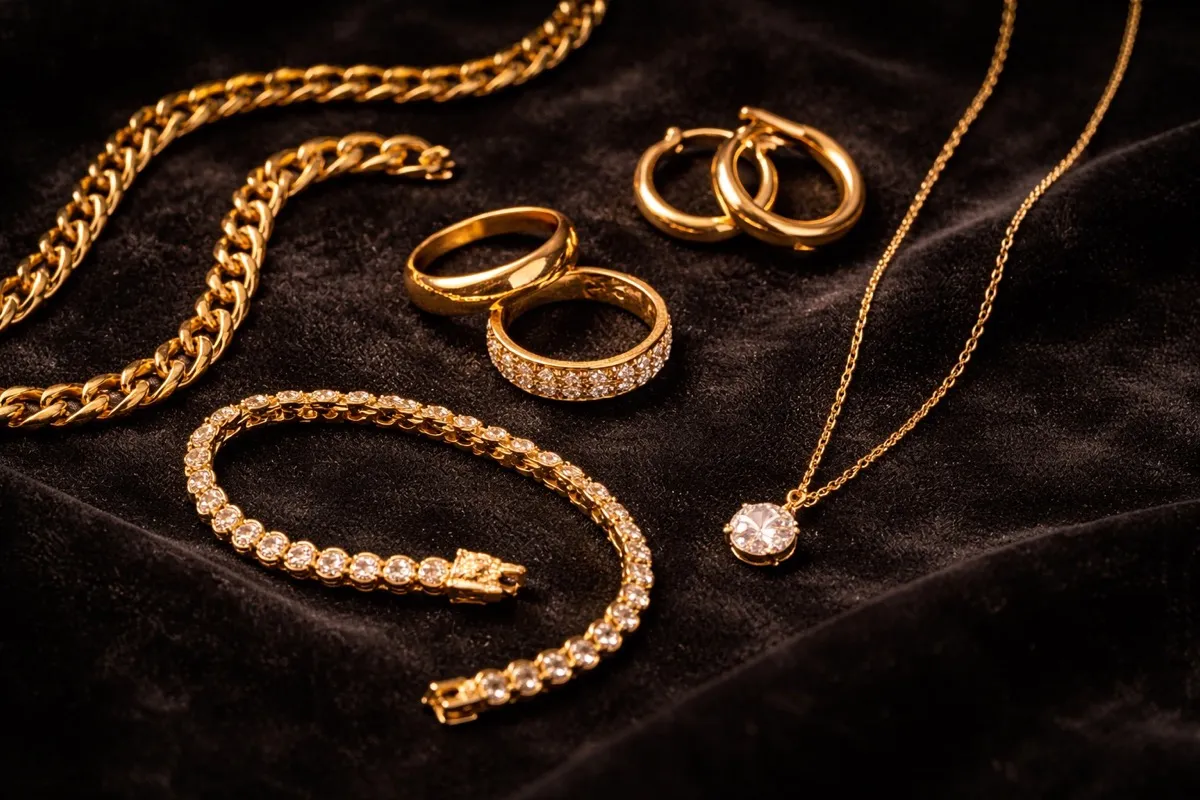
What Really Decides the Worth of a Gold Ring
Two numbers explain almost everything about a gold ring's value: the purity of the gold and the amount of it. Purity is the karat stamp inside the band, perhaps 10K, 14K or 18K. Amount is what the ring weighs after any gemstones have been set aside.
Style and label matter far less than people assume. Sold for its metal, a plain band and a showy ring with equal karat and weight settle out close together. Dents and scratches hardly register either, since the gold beneath them has not changed.
Why Gemstones Come Off the Scale First
Diamonds and colored stones get their own valuation. Weighing one with the gold would charge you for a rock at the price of precious metal, which cheats a good diamond and helps no one. So the metal is measured on its own, the gemstone is assessed apart, and both figures are spoken aloud before you make up your mind.
How Your Ring Is Read at the Counter
Whatever sets your offer is done in front of you at 769 Mountain Avenue, not behind a door. As a licensed, insured New Jersey precious metals dealer, Cash 4 Gold Trading Post must record weights carefully, and that habit is why each step is easy to follow.
A professional XRF analyzer reads the metal and confirms the karat, with an acid test behind it. Stamps wear away, many rings have none, and some pieces sold as solid turn out to be plated, so the reading is what settles it. The ring then sits on a state-approved certified scale with the display toward you, and the gold is priced from that day's live spot.
Once the numbers are in, you get a plain offer and the choice is yours. Accept it and the cash is counted out that same day. Decline and the ring goes straight back on your finger, with nothing owed for the testing.
Bring it in and watch it valued at the counter. Free, no obligation, same-day cash.
Call the Springfield store on (848) 702-0345Rings, Brooches, Cufflinks and Whatever Else Is in the Drawer
Every sort of gold ring comes across the counter: class rings from schools long forgotten, wedding bands, signet rings, chunky men's rings and the lone survivors of broken sets. They are all bought by karat and weight, with gemstones treated separately. Condition is not a hurdle, so bring them as they are.
Seldom is it rings alone, and the rest of the drawer is welcome. Anyone hoping to sell a brooch that has sat unworn for thirty years, or to sell gold cufflinks near me from a set missing a half, gets the same testing and weighing a ring receives. A stray earring, a clasp or a short length of broken chain can go in with them.
Where to Sell Gold Rings Near Springfield
The store sits on Mountain Avenue, county road 635, about a third of a mile from US 22, rather than inside a mall. That makes the trip simple whether you live in town or are driving from Westfield, Union, Cranford or Summit. Google shows 8 minutes from Westfield, 9 from Union, 11 from Summit and Cranford, and 6 from Mountainside.
Hours are Monday to Saturday, 10 AM to 6 PM, closed Sunday, and nobody needs an appointment. Plenty of people drop in after a round at Baltusrol Golf Course or an afternoon at Echo Lake Park, ring in pocket. Ring (848) 702-0345 beforehand if you like, or read the Springfield location page.
Roads people already use bring them here: Mountain Avenue, Springfield Avenue and Hillside Avenue all lead close to the door. The visit is usually short. Bring a valid photo ID, which New Jersey requires, and any questions about your pieces.
How does selling outright compare with a pawn shop or a mail-in offer?
People who search for a pawn shop are usually after one thing: cash today. If you were thinking of a pawn shop, you can sell outright here instead. It is worth seeing the routes side by side, because they differ on the one question that matters most: when you walk out, is anything still hanging over you?
Selling outright ends the transaction at the counter. You are paid the same day, the item is ours, and the sale is complete before you leave.
| How you turn it into cash | How long it takes | Who inspects it, and where | Do you keep your item | Is it settled when you leave |
|---|---|---|---|---|
| Sell outright at our Springfield counter | About fifteen minutes, paid the same day | You do, watching, at a counter it never leaves | You choose: accept and it is sold, decline and it goes home with you | Yes. The sale is final and paid in full |
| Mail it away to a buying service | One to three weeks round trip | Someone you will never meet, after it has left your hands | No. It is gone before anyone quotes you a number | Only once they pay, and you have no leverage left to negotiate with |
| Use an online instant-quote tool | Minutes for an estimate, then it becomes a mail-in | Software estimates, a person checks it later and off-site | No, once you have posted it | Only once it is mailed and paid, and the on-screen figure was never a binding offer |
| Sell privately to a stranger | Unpredictable, sometimes weeks | Nobody with testing equipment | Until money changes hands | Only if the buyer pays, and the safety and payment risk are yours alone |
If you are done with the piece, we buy outright and pay for the item itself. You leave with same-day cash.
What happens when you walk into the Springfield store?
There is no appointment, no back office and no waiting room. You walk in, what you brought is examined in front of you, and you leave with either cash or your own items, unchanged. Most visits are done in about fifteen minutes. Here is the whole sequence, so nothing about it is a surprise.
| Step | What happens | About how long | What you can do |
|---|---|---|---|
| 1. Walk in | No appointment. Bring a government-issued photo ID, which New Jersey law requires a licensed dealer to record, and whatever you want valued | Straight to the counter | Ask anything before you hand over a single piece |
| 2. Everything is sorted | Each item is identified and grouped, and anything worth more intact than broken down is set aside before any valuing starts | A few minutes | Watch it happen. Nothing goes into a back room |
| 3. It is tested in front of you | Gold, silver and platinum are read on an XRF analyzer and weighed on a New Jersey certified scale with the display facing you. Anything that is not a precious metal, such as a stone, a watch movement or a card balance, is verified on its own terms at the same counter | Two to five minutes | Read the purity and the weight yourself |
| 4. You hear one firm number | The offer is built from what was just measured against that day's live market, and every step of the arithmetic is shown to you | Minutes | Ask how any part of the figure was reached |
| 5. You decide | Accept and you are paid the same day. Decline and your items are handed straight back, exactly as you brought them in | Your call, take your time | Walk out and think about it. The appraisal was free either way |
Two details in that sequence are the ones worth insisting on anywhere you sell, not only here. Your items should never leave your sight, and you should be able to read the test result and the scale yourself. A valuation done where you cannot see it is a number you have to take on trust, and there is no reason to.
How is an offer on gold and silver actually calculated?
Every offer on precious metal comes from three numbers and nothing else: how pure the piece is, what it weighs, and what that metal is trading for on the world market at that moment. Design, brand and the price on the original receipt do not enter into it, which is the single most common surprise for a first-time seller. That is also why an honest offer can be checked by anyone with a calculator.
Metal is priced by the troy ounce, which is 31.1035 grams, not the ounce on a kitchen scale. Writing $S for the live spot price of one troy ounce of that metal on the day you sell, the melt value of a piece is:
Worked example. Take a chain that weighs 20 grams and tests at 58.5 percent pure, which is what a 14K stamp means.
- Pure metal content: 20 grams × 0.585 = 11.7 grams.
- Convert to troy ounces: 11.7 ÷ 31.1035 = 0.3762 troy ounces.
- Multiply by the live price: 0.3762 × $S is the melt value at that moment.
Swap the purity decimal and the same formula covers anything you bring. The stamps below are the ones that turn up most often at the counter, and knowing yours before you walk in means you can follow the offer as it is being built rather than simply receiving it.
| Stamp on the piece | Metal | Pure metal content | Where you usually see it |
|---|---|---|---|
| 10K or 417 | Gold | 41.7 percent gold | The legal minimum to be sold as gold in the United States; class rings, budget chains |
| 14K or 585 | Gold | 58.5 percent gold | The most common karat in American jewelry; everyday chains, rings and bracelets |
| 18K or 750 | Gold | 75.0 percent gold | Higher-end, designer and European pieces; deeper colour, more metal |
| 22K or 916 | Gold | 91.7 percent gold | Common in Indian, South Asian and Middle Eastern jewelry; soft and deep yellow |
| 24K, 999 or 999.9 | Gold | 99.9 percent gold | Bullion bars and investment coins; too soft for daily-wear rings |
| Sterling, 925 or STER | Silver | 92.5 percent silver | Flatware, tea services, candlesticks, hollowware and most silver jewelry |
| Coin silver or 900 | Silver | 90 percent silver | United States dimes, quarters and half dollars struck in 1964 and earlier |
| .999 or fine silver | Silver | 99.9 percent silver | Bars, rounds and modern bullion coins |
| PLAT, PT950 or 950 | Platinum | 95 percent platinum | Engagement settings and better watch cases; noticeably heavier than gold looks |
| GP, GF, GEP, RGP or HGE | Base metal | A trace, not solid | Plated or filled: a thin gold layer bonded over brass or steel, with little recoverable metal |
A stamp is a claim, not a guarantee, in either direction. Under-marked and unmarked pieces turn out to be solid more often than people expect, and older or imported jewelry was frequently never stamped at all. That is exactly why the piece gets tested rather than read. Two rules protect you at any counter: karats are never weighed together, because mixing them lets the whole pile be paid at the lowest purity in it, and pieces worth more intact than melted are pulled out before anything else happens.
Where is the Springfield store, and when can you walk in?
The Springfield store is a walk-in counter at 769 Mountain Ave, Springfield, New Jersey 07081. There is no appointment system and no queue to join online. Here is everything you need before you set off.
| Detail | Springfield store |
|---|---|
| Address | 769 Mountain Ave, Springfield, NJ 07081 |
| Phone | (848) 702-0345 |
| Hours, Mon-Fri | 10 AM to 6 PM |
| Hours, Sat | 10 AM to 6 PM |
| Hours, Sun | Closed |
| Appointment | Not needed. Walk in any time the doors are open |
| What to bring | A valid government-issued photo ID, required by New Jersey law, plus everything you want valued |
| Cost of an appraisal | Free, with no obligation to sell |
| How you are paid | Same day, on the spot, once you accept the offer |
Prefer to check before you drive over? Call (848) 702-0345 and describe what you have. Full directions, parking notes and the map for this store are on the Springfield location page, and the other Central New Jersey counters are listed on the locations page if a different one is closer to you.
Free appraisal, no obligation, and you keep your items if you say no.
Call Springfield on (848) 702-0345Common questions about the Springfield store
How do you work out what my gold ring is worth?
With two measurements you can check yourself: purity and weight. XRF confirms the karat, the ring sits on our NTEP-certified scale with the display facing you, and the day's live spot price turns that into a value. A diamond or colored stone is assessed on its own. The appraisal costs nothing and carries no duty to sell.
Does it matter if my ring is bent, worn or missing its stone?
Not where the gold is concerned. A scuffed, twisted or snapped ring contains the same metal it always did, so condition barely changes the offer. An empty setting only means less to value in the gemstone. Class rings, signets, wedding bands and orphaned singles are all fine in any state.
Can I sell a brooch and cufflinks in the same visit?
Yes. Brooches and cufflinks in gold are tested and weighed just as a ring is, and any gemstones are priced separately. Bring them with your rings and extras like snapped chain or one earring. Whatever is appraised and accepted is paid in cash that day at 769 Mountain Avenue, Springfield.
Is the appraisal free, and how soon am I paid?
The appraisal is free and carries no obligation. If you accept the offer you are paid the same day, on the spot at 769 Mountain Ave in Springfield. If you decline, your items are handed straight back exactly as you brought them in and you owe nothing either way. Call (848) 702-0345 first if you would rather describe a piece before you drive over.
What do I need to bring to the Springfield store?
Bring a valid government-issued photo ID, which New Jersey law requires a licensed dealer to record for every transaction, plus everything you want valued, including pieces you are not sure about. Do not clean or polish anything, because it does not raise the figure and it can damage a piece that was worth more intact. Keep matching sets together. No appointment is needed at 769 Mountain Ave, Springfield.
Keep reading before you sell
The complete New Jersey selling guide · Cash for gold near me · Frequently asked questions